THE Porsche 956, QUEEN OF THE 80'S
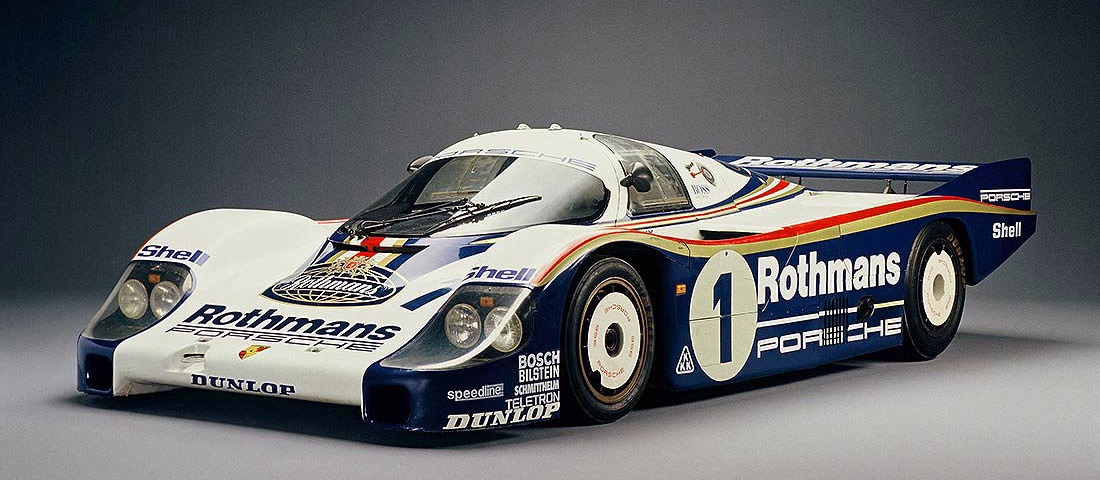
It all begins in August 1981 : The FIA introduces a new sports car prototype class into the World Sportscar Championships beginning with the 1982 season. World championships are held for these “Group C” vehicles for ten years.
The new regulations mean that Porsche has free rein to build a new racing car. The regulations mainly concern fuel consumption, so there is plenty of room for innovation.
The birth of the world champion
Under the direction of Norbert Singer, race engineers begin using the Porsche Doppelkupplung (PDK) for the first time in the 956. Another new addition is the development of the five-speed gearbox.
With its progressive injection system and 2.6-litre turbo engine, the 956 achieves a power output of 620 hp.
In particular, its unique aerodynamics make the racing car into a success story. Thanks to the strong downforce produced by the car’s underbody tunnel, drivers of the 956 reach record-breaking cornering speeds on the racetrack: The “ground effect” allows a speed of 350 km/h to be measured on the Mulsanne Straight.
After the final completion of the critical features such as the duralumin monocoque chassis, the racing car is test-driven for the first time on the test track in Weissach in March 1982.
The privilege of driving the number 001 is given to the world-class driver Jürgen Barth – who would achieve third place in the 956 at the 24 Hours of Le Mans race that same year. First and second place also go to drivers in 956 models.
The 956’s technology guarantees success
It was the beginning of a series of victories: With this model, Porsche does not only win all of the FIA World Sportscar Championship titles between 1982 and 1984, it collected both the drivers’ and manufacturers’ championships on each occasion. In addition, Stefan Bellof drives a 956 (chassis no. 007) around the Nordschleife of the Nürburgring in a record-breaking time of 6 minutes 11.13 seconds, which remains a record even today.
Drivers, designers and racing fans are captivated by the unique capabilities of the 956 – in 1983 and 1984, Porsche’s engineers even build copies for customers.
Race history / Major wins :
1982 24 Hours of Le Mans (Derek Bell / Jacky Ickx in 956-002)
1982 Spa 1000 km (Jacky Ickx / Jochen Mass in 956-003)
1982 Fuji 6 Hours (Jacky Ickx / Jochen Mass in 956-003)
1982 Brands Hatch 1000 km (Jacky Ickx / Derek Bell in 956-003)
1983 Monza 1000 km (Bob Wollek / Thierry Boutsen in 956-104)
1983 Silverstone 1000 km (Stefan Bellof / Derek Bell in 956-007)
1983 Nurburgring 1000 km (Jacky Ickx / Jochen Mass in 956-005)
1983 24 Hours of Le Mans (Al Holbert / Vern Schuppan / Hurley Haywood in 956-003)
1983 Spa 1000 km (Jacky Ickx / Jochen Mass in 956-005)
1983 Fuji 1000 km (Stefan Bellof / Derek Bell in 956-009)
1983 Kyalami 1000 km (Stefan Bellof / Derek Bell in 956-009)
1984 Monza 1000 km (Stefan Bellof / Derek Bell in 956-009)
1984 Silverstone 1000 km (Jacky Ickx / Jochen Mass in 956-010)
1984 24 Hours of Le Mans (Henri Pescarolo / Klaus Ludwig in 956-117)
1984 Nurburgring 1000 km (Derek Bell / Stefan Bellof in 956-009)
1984 Brands Hatch 1000 km (Jan Lammers / Jonathan Palmer in 956-106)
1984 Mosport 1000 km (Jacky Ickx / Jochen Mass in 956-010)
1984 Spa 1000 km (Stefan Bellof / Derek Bell in 956-009)
1984 Imola 1000 km (Stefan Bellof / Hans-Joachim Stuck in 956-116)
1984 Fuji 1000 km (Stefan Bellof / John Watson in 956-009)
1984 Sandown Park 1000 km (Stefan Bellof / Derek Bell in 956-009)
1985 24 Hours of Le Mans (Paolo Barilla / Klaus Ludwig / John 'Winter' in 956-117)
1986 Norisring 200 mile (Klaus Ludwig in 956-117)
1986 Brands Hatch 1000 km (Bob Wollek / Mauro Baldi in 956-106B)
1986 Fuji 1000 km (Paolo Barilla / Piercarlo Ghinzani in 956-117)